BEGINNER FITNESS
Starting Movement: Notes on the First Weeks
Eleanor Whitfield · 14 January 2026 · 9 min read
Bodyweight exercises occupy a particular position in beginner fitness literature. They require no equipment, are performable in any domestic space with a clear four-square-metre floor area, and cover all major movement patterns — push, pull, hinge, squat, and carry. For someone at the starting point of a structured movement routine, they are sufficient for the entirety of the first training cycle.
The warm-up sequence precedes every session. Its function is to raise core temperature, increase joint mobility, and activate the muscle groups that will be used in the working portion of the session. For a beginner home session, a warm-up of five to seven minutes is sufficient and should include the following elements in order.
Two minutes of light marching in place or slow stepping up and down from a low step establishes an elevated heart rate. One minute of shoulder circles — ten circles forward, ten backward — addresses upper body mobility. One minute of hip circles and hip flexor mobilisation addresses lower body mobility. The final two minutes of the warm-up consist of slow, partial-range bodyweight squats: eight to ten repetitions performed at half depth, with the primary objective of joint preparation rather than muscular activation.
The warm-up is not optional for a beginner. Published exercise guidance is consistent in noting that the injury rate in the first weeks of a training programme is highest when sessions begin without adequate preparation, and that the preparation time required is short relative to the risk reduction it provides.
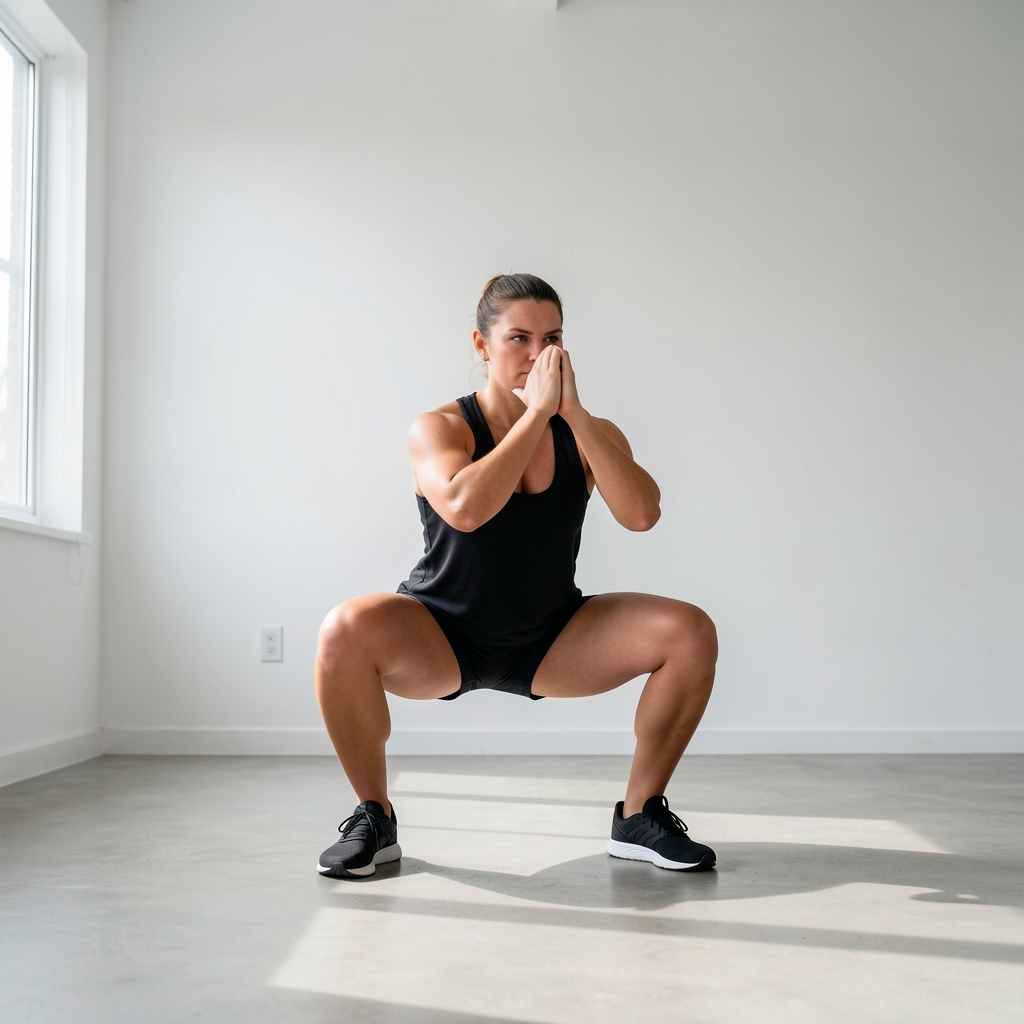
Stand with feet shoulder-width apart, toes turned out slightly. Lower by bending knees and hinging at hips until thighs approach parallel. Return to standing. Keep chest lifted throughout.
Begin from knees (modified) or toes (standard). Hands placed slightly wider than shoulder-width. Lower chest toward floor maintaining a straight line from head to knees or heels. Push back to start.
Lie on back with knees bent, feet flat on floor hip-width apart. Press through heels to raise hips until body forms a straight line from knees to shoulders. Hold two seconds at top. Lower with control.
Begin from forearms and knees (modified) or forearms and toes (standard). Keep body in a straight line, core braced. Hold for the target duration without allowing hips to rise or sag. Breathe steadily throughout.
The bodyweight squat is the most technically complex of the four beginner exercises, and the one most commonly performed with form errors that reduce its effectiveness and increase the load on unsupported joints. The two most observed errors are forward knee travel beyond the toes (often the result of restricted ankle mobility) and rounding of the lower back at the bottom of the movement (often the result of limited hip mobility).
Both errors resolve with consistent practice over two to three weeks. In the interim, reducing depth — stopping the descent before the point at which the form breaks — is the documented adjustment. A half-squat performed with correct form builds the mobility and strength required for a full-depth squat more effectively than a full-depth squat performed incorrectly.
The modified push-up is the appropriate variant for most beginners in the first two to three weeks. The modification — performed from knees rather than toes — reduces the load to approximately sixty percent of bodyweight, which is a manageable resistance for someone with no upper-body training history. Progression to the standard push-up is appropriate when six to eight clean repetitions can be performed in the modified position without form breakdown.
The plank hold duration for beginners is typically fifteen to twenty seconds. This is a shorter hold than is often assumed, and that brevity is appropriate: a well-maintained fifteen-second hold trains the target musculature more effectively than a thirty-second hold performed with hip sag or compensatory breathing. Duration increases are made in five-second increments, not by doubling.
The cool-down stretch sequence follows the working portion of the session. Its function is to return the musculoskeletal system to a resting state, reduce post-session stiffness, and provide a defined endpoint to the session — a psychological signal that the session is complete.
A five-minute cool-down appropriate for the four exercises above includes: a standing quadriceps stretch (thirty seconds per leg), a lying hamstring stretch (thirty seconds per leg), a seated hip flexor stretch (thirty seconds per side), a child's pose (sixty seconds), and a lying thoracic rotation (thirty seconds per side). Total duration: approximately five minutes.
Each stretch is held as a static position. No bouncing or forced extension. The stretch is taken to the point of mild tension — not discomfort — and held there for the target duration. The muscles being stretched are the ones most directly loaded in the preceding session. This specificity is why a generic full-body stretch sequence is less effective than one matched to the session content.
Mobility drills sit between the warm-up and the working exercises in terms of their function. They are not warm-up movements — they are movements designed to improve the range of motion available at a joint, rather than simply to prepare the joint for the session. For a beginner with a sedentary baseline, mobility limitations are often the most significant constraint on exercise quality.
The hip flexor is the mobility target most relevant to the four-exercise beginner selection. Sustained seated posture — the default daily posture for most adults — produces a shortening adaptation in the hip flexor complex that directly limits squat depth and glute bridge activation. A ninety-second hip flexor stretch per side, performed before the working exercises, addresses this limitation progressively over weeks one through four.
Ankle mobility is the secondary target. Restricted ankle dorsiflexion is the most common cause of forward knee travel in the bodyweight squat. A simple ankle circle sequence — ten circles clockwise and ten counterclockwise per ankle — performed in the warm-up provides both mobility work and joint preparation simultaneously.
Progression within the four-exercise selection follows observable signals rather than a fixed schedule. For the squat, the progression signal is the ability to complete three sets of twelve repetitions with full depth and no form breakdown. The progression is to add a third set, or to introduce a two-second pause at the bottom of the movement.
For the push-up, the progression signal is the completion of two sets of eight modified push-ups with no form breakdown. The progression is to transition to standard push-ups, beginning with two sets of four to six repetitions from toes.
For the glute bridge, the progression is a single-leg variant: one foot lifted, the bridge performed on a single planted foot. This increase in load is significant — the single-leg bridge is substantially harder than the bilateral version — and should be introduced cautiously, with two to three bilateral sets maintained alongside one or two single-leg sets.
For the plank, the progression is duration. Each five-second increment is added only when the current duration can be held for the full count across both sets without compensatory form. From thirty seconds, the next progression stage is a side plank: a lateral variant that adds oblique engagement to the core stability base.

Eleanor Whitfield is the lead editor of Traloven Letters. Her work covers the intersection of habitual movement, beginner-level fitness practice, and the documentation of accessible exercise routines. She holds a background in editorial journalism.
Also by this writer: Starting Movement: Notes on the First Weeks →